The afterlife of ideas
Some arguments only become readable years after they were made. A reader can learn to wait for them.
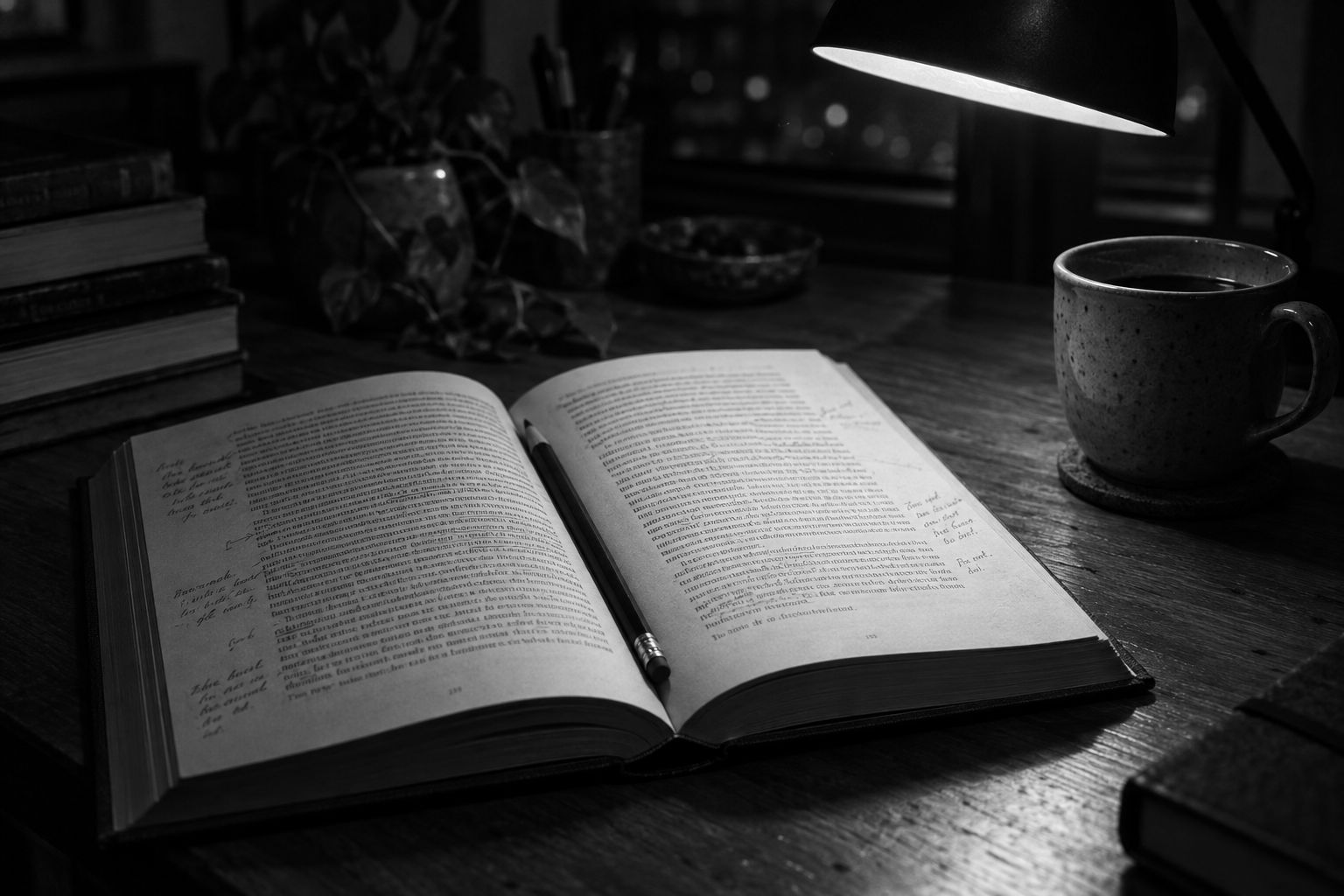
There is a kind of book that does nothing for you the first time. You read it because someone said you should, you underline two sentences out of politeness, and you put it back on the shelf with the faint embarrassment of a guest who missed the joke. Ten years later, for reasons that have nothing to do with the book, you take it down again and find that every page has been waiting for you.
Spinoza does this to a great many people. At twenty the Ethics reads like a legal contract drawn up by a geometer, all definitions and propositions and corollaries, and it is hard to see why anyone would want to live inside it. Fifteen years on, after a bereavement or a long winter, a reader opens it at random and lands on the passage where the mind is said to be able to relate every affection of the body to the idea of God. Few of us could explain exactly what that means. Plenty of us have read it four times standing in the hallway with our coats still on.
The book had not changed. The reader had.
Born posthumously
Nietzsche saw this coming for himself. In the foreword to The Antichrist he wrote that only the day after tomorrow belonged to him, and that some people are born posthumously. It is easy to hear vanity in that line, and there is some. There is also a plain observation about how ideas travel. They leave their authors early. They arrive at their readers late. In between they spend years in libraries, in footnotes, in the half-remembered remarks of teachers, waiting for a life that will finally give them a use.
The history of science is full of these delays. Gregor Mendel published his work on pea plants in 1866 and was largely ignored until three botanists, working independently, arrived at the same results in 1900 and went looking for precedents. Emily Dickinson saw fewer than a dozen of her poems in print while she was alive. The rest were found in a locked box after her death, almost eighteen hundred of them, sewn by hand into little booklets.
Ideas leave their authors early and reach their readers late.
None of this is mysterious. An argument depends on a context to be understood, and contexts take time to assemble. Mendel needed a biology that was asking his question. Dickinson needed readers who could hear a dash as a breath. The idea sits there, complete, until the world catches up with it, and then everyone wonders why nobody noticed.
The slow reader
What interests us more is what happens on the reader's side. Every serious reader carries around a private stock of things they have read and not yet understood. Most of the time this stock is invisible. Then something happens in ordinary life, a loss, a move to another country, a child, an argument that goes badly, and one of those dormant sentences wakes up.
The feeling is unmistakable. It is close to recognition, the sense of meeting someone you already know. You did not learn the idea at that moment. You learned it years ago and stored it without knowing what it was for. Your own life simply arrived, late, to meet a sentence that had been waiting.
This is why we distrust the idea that a book can be finished. You can reach the last page, certainly. You can write a review, give it a score, and move on to the next title. But the book has not finished with you. It goes on working quietly for as long as you remember any of it, and sometimes longer, because what you forget can still change the shape of what you notice.
A case for patience
Most of what reaches us now is built for the opposite tempo. News is designed to be finished by lunchtime. Feeds are designed never to be finished at all. Neither has any room for the sentence that needs a decade to land, and neither rewards the reader who puts something down unresolved and lets it sit.
A publication that takes ideas seriously has to make a small, stubborn wager against that tempo. The wager is that some things are worth reading now precisely because you will only understand them later. It asks a lot of a reader. It asks you to tolerate a certain amount of not getting it. It asks you to keep books you did not enjoy, and to return to them without guilt when the time comes.
That is part of why we chose the night. The dark does not make anyone wiser. The night is simply quieter, and the quiet makes it possible to hear an argument to the end, even an argument that has been waiting years for you to be ready.
So keep the difficult book. Leave the pencil marks where they are. One evening, coat still on, you may find that it was written for you after all.