A Paris bookshop after rain
The streets around the Odéon at closing time, and the conversations that outlast them.
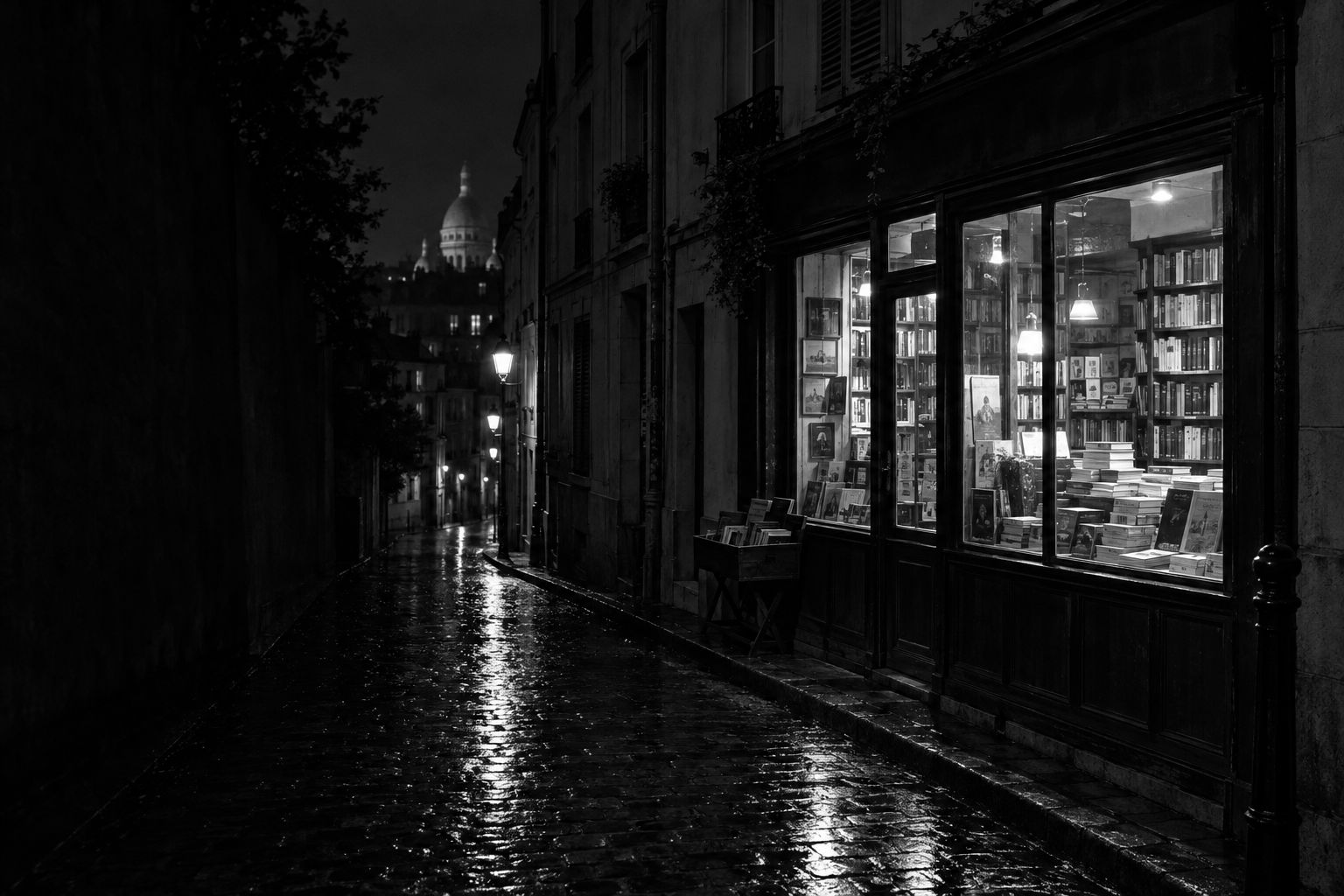
The rain had stopped about ten minutes before, and the street still had that varnished look Paris gets after a shower, every cobble outlined in light. A bookshop on the corner was the only thing still open. Its window was stacked with the autumn's new novels, the rentrée littéraire, a few hundred titles fighting for space in a country that still treats the publishing season as something close to a national event.
Inside, the owner was talking to a customer about a translation. Neither of them seemed in any hurry. The door had been propped open to let out the damp, and their conversation drifted onto the pavement where two students were sheltering under the awning, pretending not to listen.
A street with a history
These streets around the Odéon have been home to this kind of conversation for a long time. In 1921 an American named Sylvia Beach moved her bookshop, Shakespeare and Company, to number 12 rue de l'Odéon. Across the road, at number 7, Adrienne Monnier ran La Maison des Amis des Livres, a French bookshop and lending library that was as much a salon as a shop. Between the two of them, for the better part of two decades, that short street was one of the busiest literary crossroads in Europe.
Beach published Ulysses in 1922 when no one else would touch it. Monnier's shop hosted readings by writers who were not yet famous and some who never would be. Both women lent books to people who could not afford to buy them and fed people who could not afford to eat. The shops were businesses, but they were also something harder to define, places where a city's readers could find each other.
A good bookshop is a place where a city's readers can find each other.
Beach's shop closed in 1941 during the occupation. Monnier's lasted until 1951. Neither address holds a bookshop now. The street has kept something of its old atmosphere all the same, and the quarter around it still has more bookshops per hectare than almost anywhere in the world.
Why they survive
Every few years someone predicts the end of the independent bookshop, and every few years Paris proves them wrong. Part of the reason is policy. A French law of 1981, the loi Lang, fixes the price of new books so that a small shop cannot be undercut by a large one. Part of the reason is habit. Many Parisians simply expect to buy their books from a person who has read some of them.
The rest is harder to measure. A good bookshop gives you things no website can. A recommendation from someone who knows the stock. A table of books you would never have searched for. A conversation with a stranger about a novel you have both just finished, which may be the main reason many of us read novels at all.
Closing time
By the time the owner began switching off the lights, the customer had bought two books, neither of which she had come in for. The students under the awning had gone. The street was drying, the light in the puddles beginning to break up as a delivery van went past.
It would be easy to make too much of a scene like that. A shop, a sale, a conversation about a translation. Still, it is the kind of evening that makes a city feel inhabited by its readers. Paris has a great many of those evenings. They are worth walking out in the rain to find.